

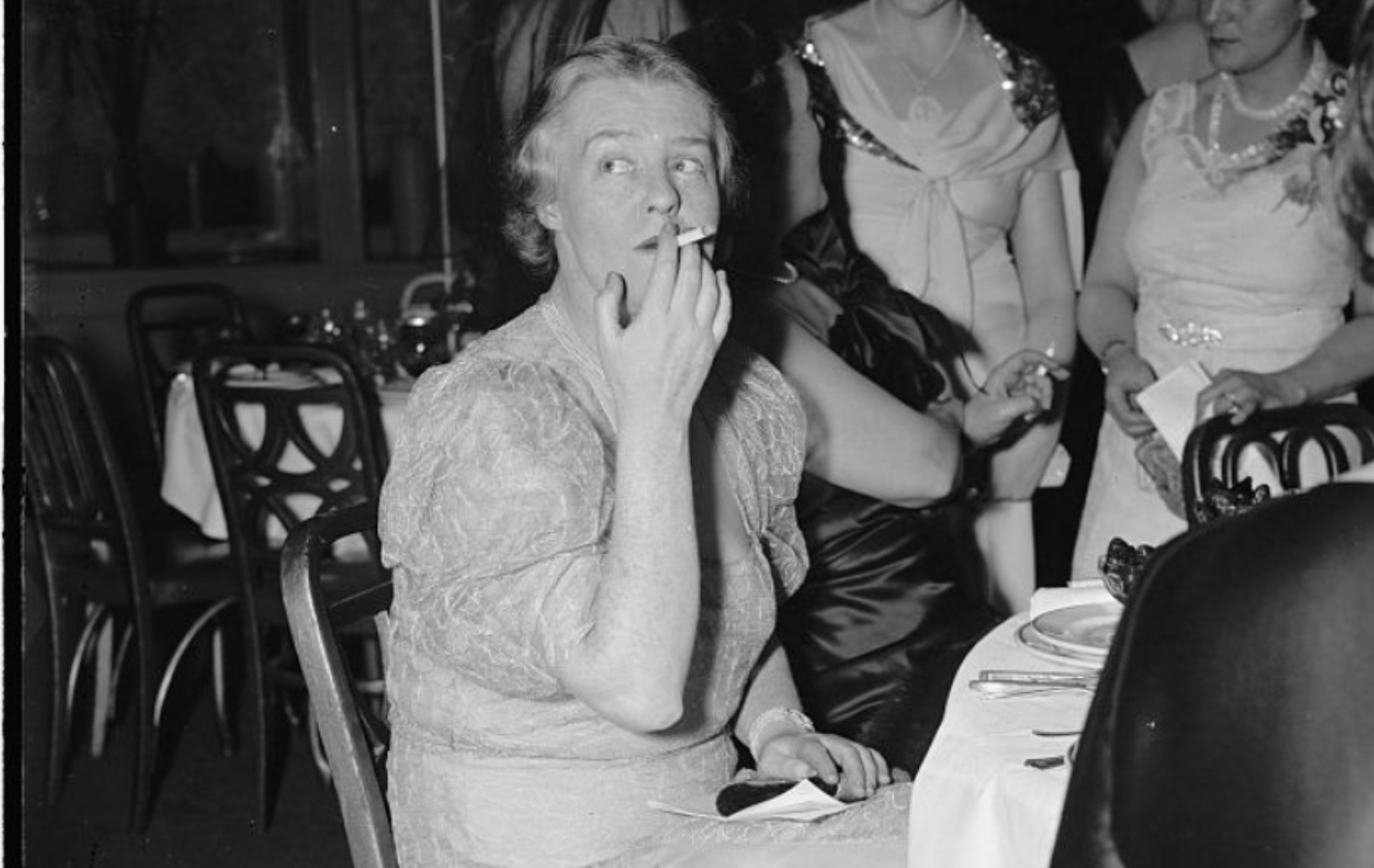
Most guests who arrive at Twin Farms in Barnard, Vermont know they’re checking into one of the finest small hotels in North America. Fewer know they’re sleeping inside the former home of Dorothy Thompson, one of the most extraordinary women of the twentieth century.
If you haven’t heard of her yet, pay attention now.
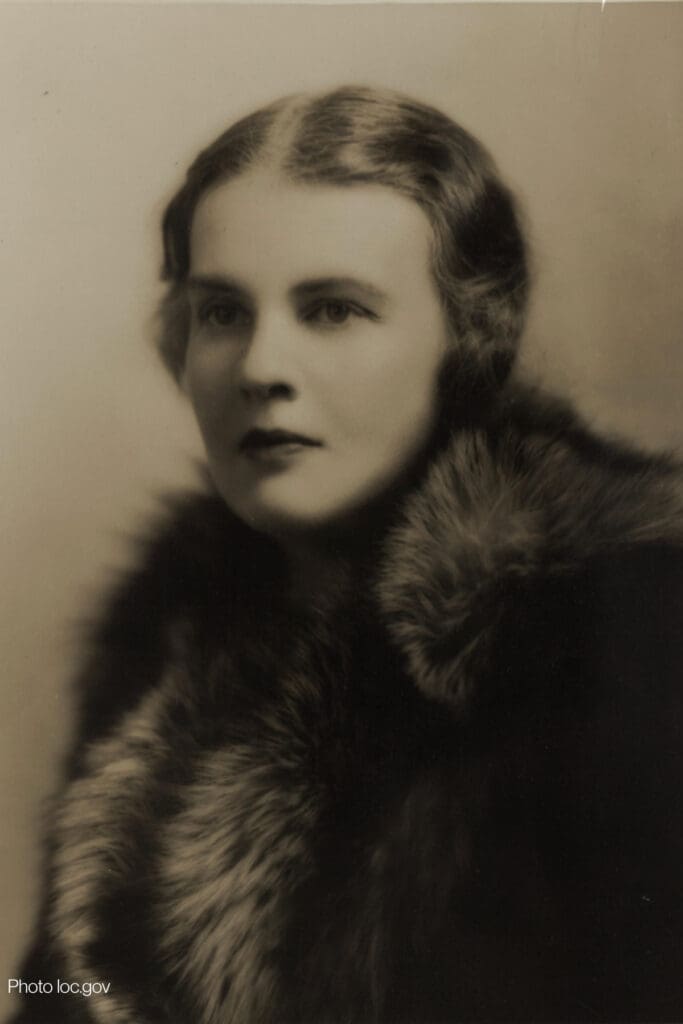
She said “Yes, but…”
In 1927, Sinclair Lewis was already one of the most celebrated novelists in the world. He would become, three years later, the first American to win the Nobel Prize for Literature (flex). Dorothy Thompson was a foreign correspondent based in Berlin, known for her sharply written dispatches from a Europe that was sliding quickly toward catastrophe. The second time the two met it was at a dinner party in Berlin. Lewis proposed that evening. Obviously Dorothy was a catch.
But she was not easily woo’d. She agreed to marry him on exactly one condition: that he buy her a farm in Vermont with sweeping lawns, orchards, and what she called “delicious air.” (Honestly, me too, girl. The air around me is decidedly un-delicious.)
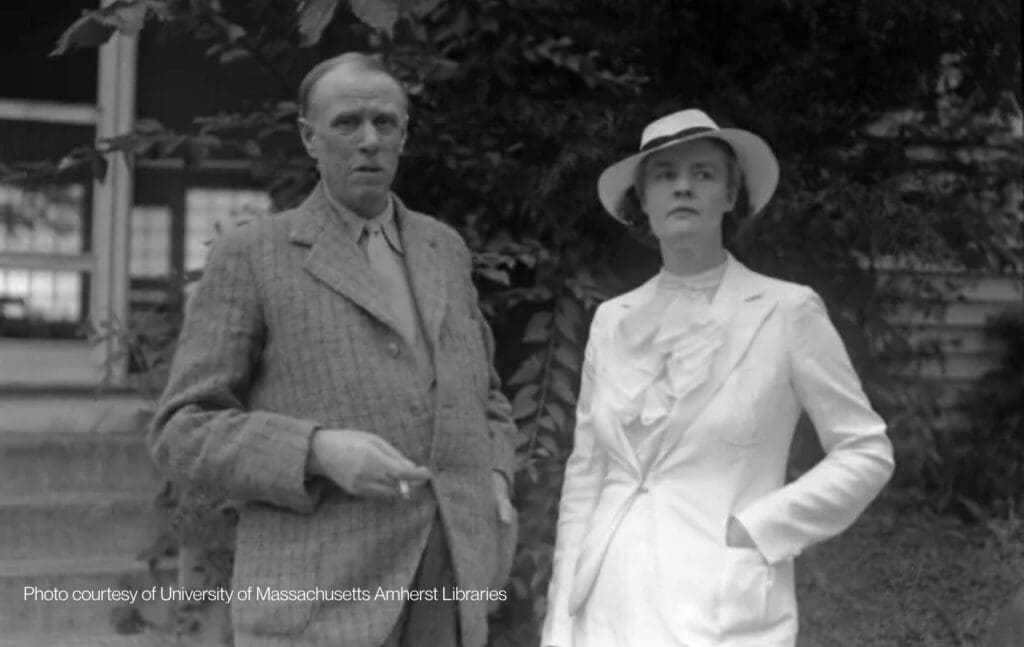
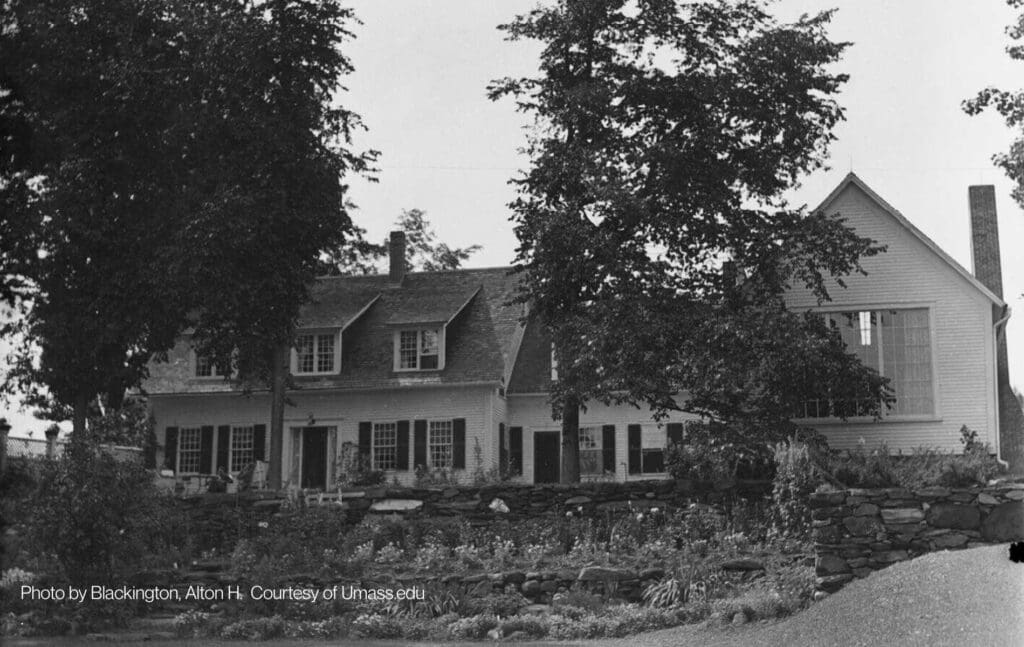
He found it in Barnard. In 1928 they purchased a circa 1795 farmhouse on 300 acres for $10,000. They named it Twin Farms, and for the next three decades it became their warm-weather home, their writing retreat, and the setting for some of the most interesting gatherings in American intellectual life.
It was intellectual Gatsby.
This Woman Insulted Hitler.
To understand what Twin Farms meant to Dorothy Thompson, it helps to understand what her life outside Vermont looked like.
In 1931, Dorothy became the first American journalist to interview Adolf Hitler. The profile she published was … withering. She described him as “formless, almost faceless, a man whose countenance is a caricature, a man whose framework seems cartilaginous, without bones. He is inconsequent and voluble, ill-poised, insecure. He is the very prototype of the Little Man.”
“Cartilaginous” (!!) She essentially called Hitler soft. In print. Hitler was not amused.
In August 1934, by Hitler’s personal order, Dorothy was expelled from Germany, becoming the first American journalist formally forced out of the Third Reich. (*Yes* girl.) The Gestapo delivered the notice to her hotel room in Berlin. She had 24 hours to leave the country.
She had the expulsion order framed. (ART)
Back in the United States, news of her expulsion made her a kind of influencer of the day. She launched a syndicated newspaper column, “On the Record,” eventually carried by more than 170 papers and read by ten million people. She added a weekly radio broadcast on NBC. In 1939, Time magazine gave her a cover and named her the second most influential woman in America, after Eleanor Roosevelt only. She was also, in the view of many, the more interesting of the two. (obviously. No shade to Eleanor)
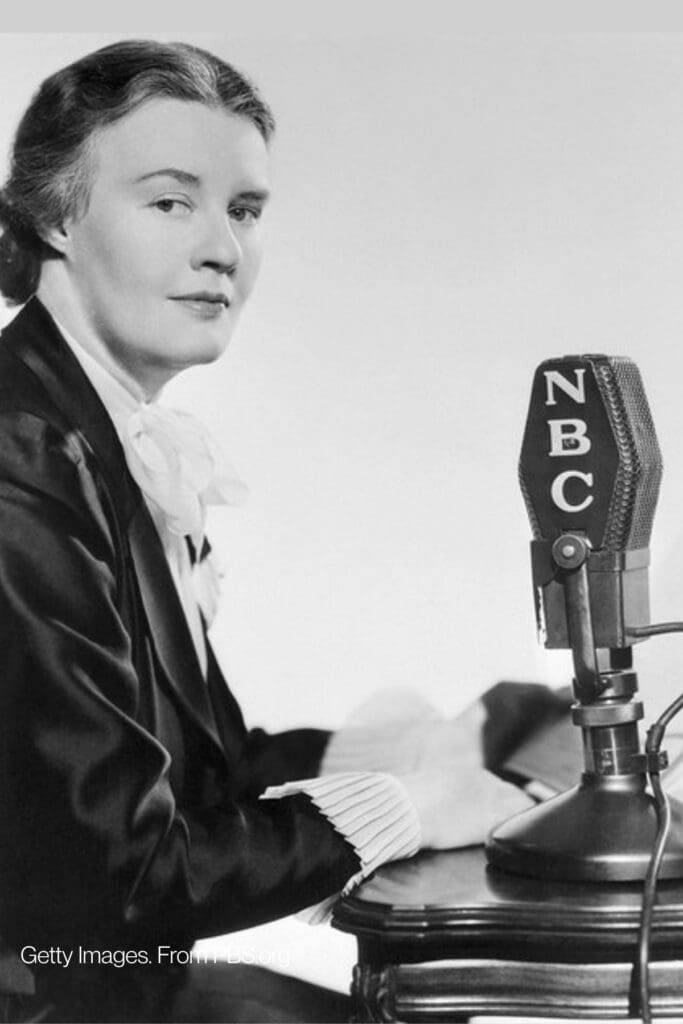
It was at Twin Farms that her husband Sinclair, shaped by Dorothy’s reporting and urgency, wrote his 1935 novel “It Can’t Happen Here,” a cautionary tale about fascism taking hold in America set in a fictional Vermont town, at a frenzied pace over the course of that summer. Sound…timely?
The Parties
Dorothy’s July 9th birthday was a fixture of the Vermont social calendar throughout the 1930s and 40s. More than fifty people would descend on Twin Farms for tennis, swimming at nearby Silver Lake, and an evening that reliably ended with a heavy Viennese meal, strong spirits, and, for the light sleepers, the sound of Thompson’s typewriter in the early morning hours after the guests had collapsed.
The guest list was not the usual country house crowd.
Among the regular visitors were H.L. Mencken, the acid-tongued essayist and critic, and Bernard DeVoto, the historian and literary editor. George Seldes, the fearless journalist who lived just down the road in Woodstock, was another fixture. German playwright Carl Zuckmayer, whom Dorothy had personally helped flee Nazi Germany with his wife and daughter, spent time at Twin Farms after arriving in America. Thompson had first taken them into her own New York apartment, then arranged a house for them in Barnard. (queen behavior)
And then there were the neighbors.
The Baron and Baroness de Rothschild kept a property at Ellis Farm in nearby East Barnard. (as one does) Baron Louis de Rothschild had been arrested by the Gestapo at the Vienna airport in March 1938, following the Anschluss, and held until his family negotiated his release in 1939 upon payment of what was reported to be $21 million, believed at the time to be the largest ransom paid for any individual in history.
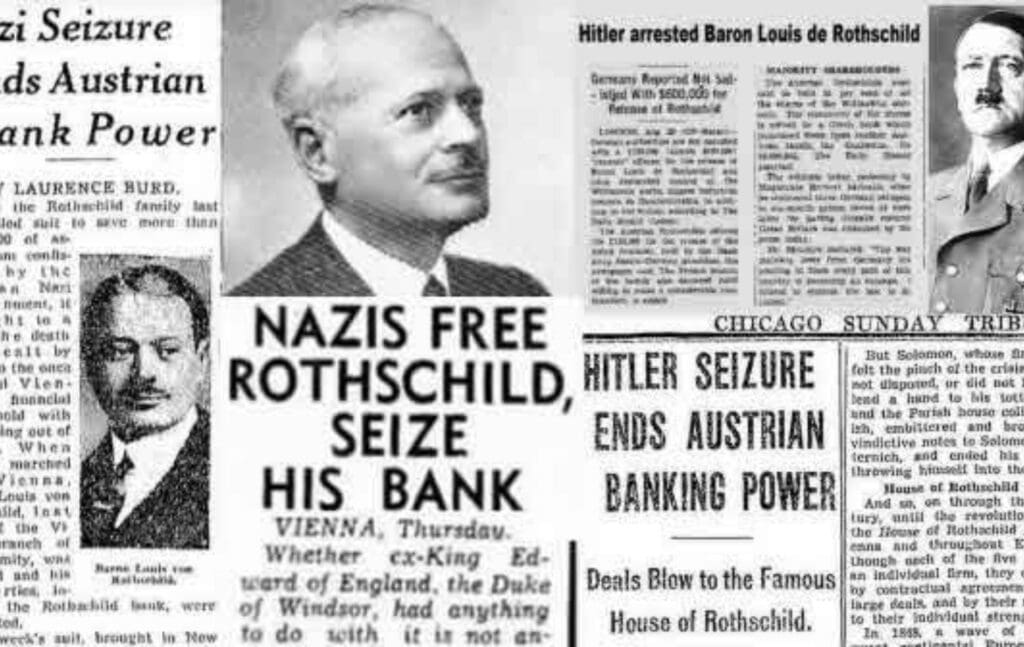
The fact that the Rothschilds, a handful of war refugees, a Nobel laureate, and a woman who personally insulted Hitler all ended up at birthday parties on a farm in Barnard, Vermont is either the greatest coincidence of the twentieth century or proof that Dorothy Thompson had one of the most extraordinary gravitational pulls of anyone in her era.
Twin Farms After Dorothy
Dorothy and Sinclair separated in 1938. He deeded her Twin Farms in the settlement, and she kept it until she grew too frail to manage it. Her family sold off parcels through the 1950s, completing the final transaction in 1958. Dorothy died in Lisbon in January 1961.
The property changed hands several times over the following decades. Thurston Twigg-Smith, a businessman and art collector from Hawaii, acquired it in 1974 as a private family retreat. In the late 1980s, finding himself able to visit only a few weeks each year, he decided to share it. Twin Farms opened as a hotel in 1993.
Twigg-Smith engaged interior designer Jed Johnson to reimagine the original accommodations. Johnson had come to prominence through his long association with Andy Warhol, and had built a celebrated design practice with a client list that ran from Mick Jagger to Yves Saint Laurent. He was, by every account, at the absolute peak of his career.
Sadly, he died in the crash of TWA Flight 800 in July 1996, just three years after Twin Farms opened. He was 47.
The art collection Twigg-Smith brought with him, including works by David Hockney, Jasper Johns, and Cy Twombly, has remained. So has everything else that makes Twin Farms what it is.
Today the property holds 28 individually designed accommodations across the original Main House, cottages, a farmhouse, and treehouses set into the wooded hillside. Two of the guest suites in the Main House are named Dorothy’s Room and Red’s Room, Red being Sinclair Lewis’s nickname. The 15,000-bottle wine cellar, the farm-to-table dining, the private ski mountain, the fly-fishing pond, and the near-total seclusion are all very much present as Dorothy would have liked them.
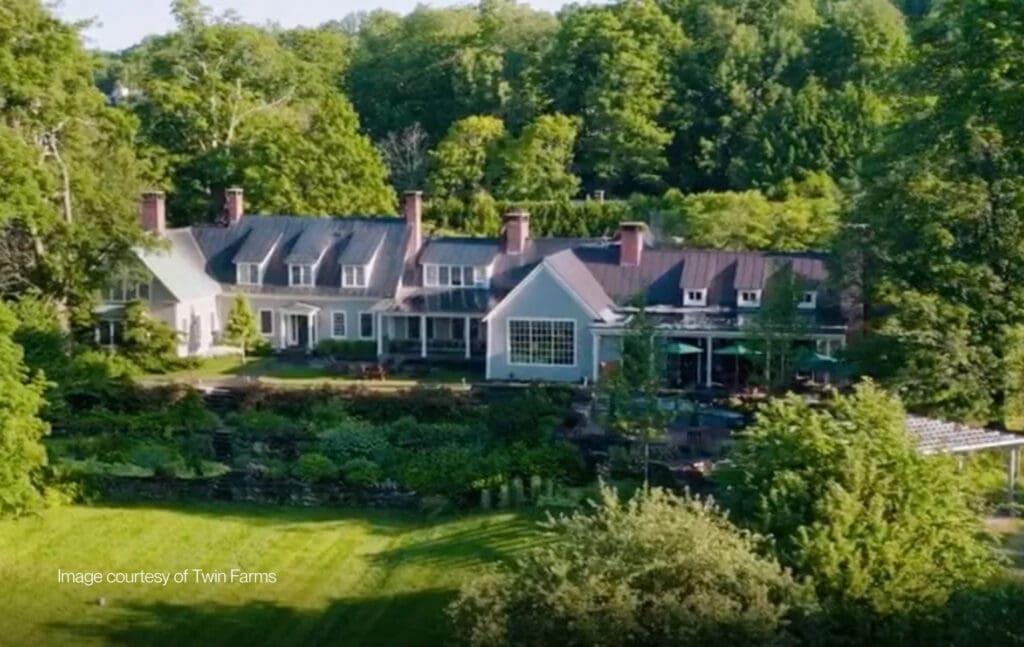
The farmhouse that Dorothy requested as the price of her hand in marriage is still at the center of it.
The “delicious air” has not changed.
Visiting Dorothy Thompson’s Twin Farms Today
Dorothy Thompson’s Twin Farms is a Relais & Chateaux property, adults-only for most of the year, and fully all-inclusive. It sits about 90 minutes from Burlington and three hours from Boston. Rates vary seasonally, from approximately $2,800 per night, double occupancy.
If this has you curious about other properties across North America that capture a genuinely European sensibility without the transatlantic flight, I’ve written a broader piece on exactly that. You can find it here.
And if Twin Farms itself is now on your list, I’d love to help you plan it. Get in touch.


